

George Love, Pastor of Hebron Presbyterian Church, will be sharing his thoughts on the Daily Lectionary Series of Bible readings. You will find his most recent comments at the top, with earlier ones below.
We have also added daily links to Presbyterian Church (USA) website where you will find the Scripture readings for that day. We hope you will find this a helpful way to join us in seeking God's message for our daily lives.
January 31
First Reading:
Genesis 18:1-16
Psalm: Psalm 122
Second Reading:
Hebrews 10:26-39
Gospel: John 6:16-27
"I was glad when the said to me, 'Let us go to the house of the Lord!'" - Psalm 122:1
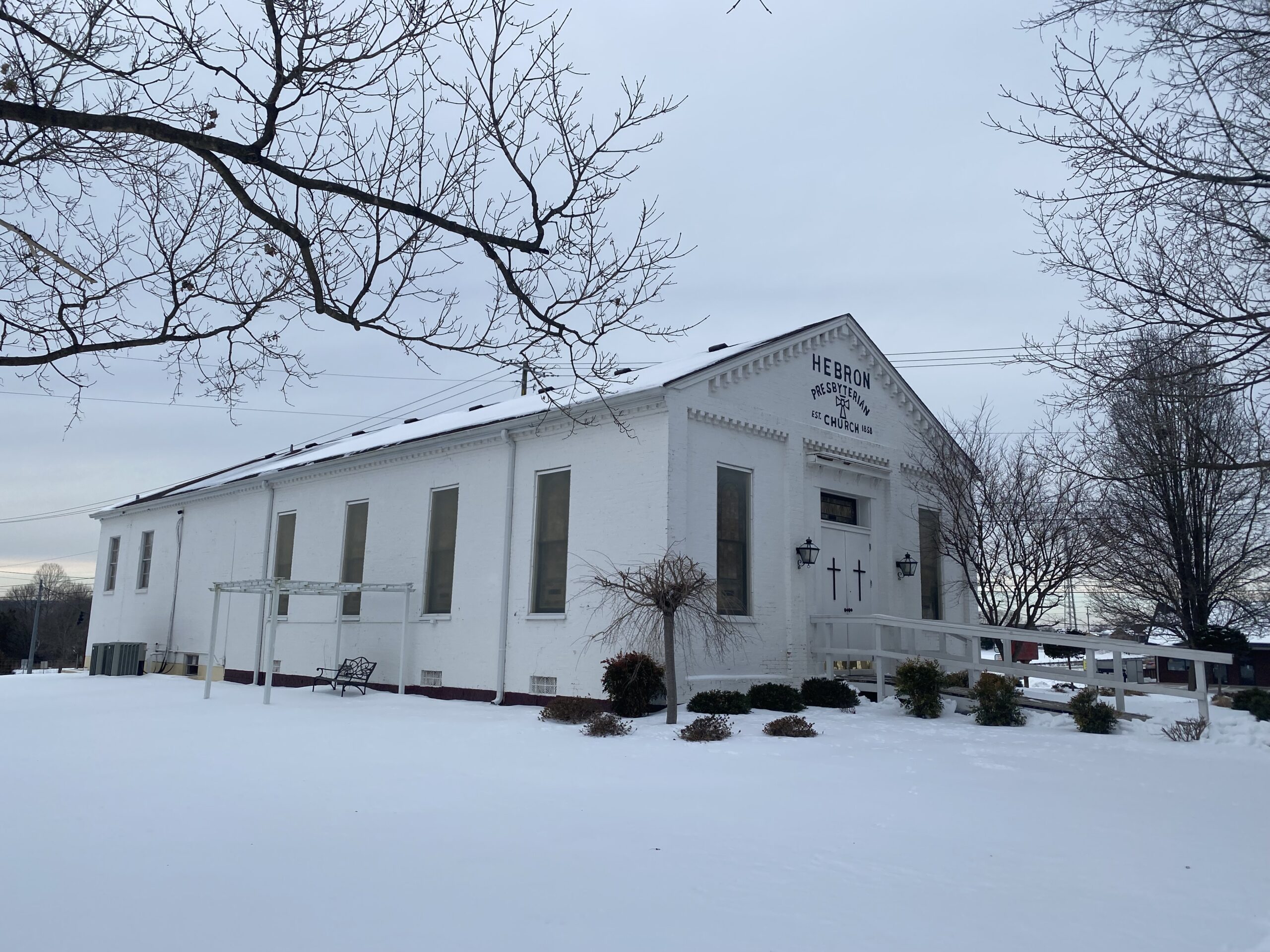
It is Saturday as I am writing this. One week ago we were in the beginning stages of a winter storm that brought different combinations of snow and ice all over our area. By Sunday morning, many people could not get out and if they could get out, the church was not able to receive them, the parking lot and the sidewalks were covered and becoming increasingly covered as the hour for worship came and went.
It's still very cold here. Very cold for us means single digit temperatures with wind chills below zero in some instances. However, the streets are clear, the church parking lot and sidewalks are clear, and it is possible for us to gather for worship tomorrow. There will be some who will still not be able to make it, but we will be open for worship tomorrow for those who are able to get out. (And we will have worship posted online for those who cannot get here.)
I received a message from a church member, our organist, Joyce, this week that read, "I hope we can have church on Sunday." I felt exactly what she was saying. There is nothing like gathering together as the body of Christ for worship. It is good to be together to share our joys and concerns and to offer praise to God. The effort that went into the removal of the snow and ice from the parking lot (thank you again Mike and Rick) so that we can walk into the building bears witness to the power of what we find in that space when we gather together.
"I was glad when they said to me, 'Let us go to the house of the Lord,'" wrote the Psalmist. More than two thousand years later, on a frigid Kentucky day, we get it and we too are glad.
January 30
First Reading:
Genesis 17:15-27
Psalm: Psalm 88
Second Reading:
Hebrews 10:11-25
Gospel: John 6:1-15
"And let us consider how to provoke one another to love and good deeds, not neglecting to meet together..." - Hebrews 10:24-25
When we think of being provoked, we may think of being annoyed. One definition I found for the word suggested something that brings about a strong and perhaps unwelcome feeling. So, it is indeed thought-provoking to see the word provoke deployed as it is here, directing the church to stimulate love and good deeds in each other.
N.T. Wright translates the verses above this way: "Let us, as well, stir up one another's minds to energetic effort in love and good will." (Hebrews 10:24)
However we view it - provoke, stir up - it's a wonderful reminder of what we are to be about when we gather. We should energize and encourage each other to live in ways that inspire love, and from that love learn to act in ways that are positive and life-giving for folks beyond ourselves.
The Gospel reading today is back in John 6 again, and maybe this is exactly what is happening in the story of Jesus feeding the five thousand. Jesus is provoking the disciples to imagine what is possible as his followers. May we be provoked as well and inspired to positive, caring service as we follow Jesus.
January 29
First Reading:
Genesis 16:15-17:14
Psalm: Psalm 143
Second Reading:
Hebrews 10:1-10
Gospel: John 5:30-47
"And I will make my covenant between me and you..." - Genesis 17:2
When I was in kindergarten we had a workbook we spent time with most days called Puzzle Pages. It was a lot of paste, and scissors, and crayons. It was great fun, but it was also work and sometimes frustrating. Cutting the lines straight could be a challenge. Getting the paste to spread smoothly and not make big clumps. As we day after day added to its pages, our workbooks developed a certain puffiness. The pages no longer lay flat, the bulkiness a result of our artistic efforts. Mrs. Wheeler, our teacher, was always encouraging and always seemed pleased with our efforts, sometimes even when we were not.
Today's passages point to the Puzzle Pages nature of our faith. God reaches out to Abraham with covenant promises. Hebrews works with the idea of sacrificial offering, using the lens of Christ's self-giving love. In John, Jesus teaches about how his life and ministry offers instruction about God's glory. In each instance there is indication that our faith, our understanding of our relationship with God, is always in motion and always a work in progress.
Each new day brings new factors to be worked out in our relationship with God. While God may be the same yesterday, today, and forever, we are not and our world is not. As a result we are always working out what concepts like covenant and sacrifice mean in the reality of the current day. There is a necessary taking into account of the ever changing nature of where we have been, where we are, and where we are going. I feel at times like my faith journey might look like my Kindergarten Puzzle Pages. Not always getting it right, with an end result that is puffy and imperfect. Perhaps the good news of grace and forgiveness is that God, like my teacher from all those years ago, is always encouraging, even in moments when I feel I've missed the mark. And tomorrow we get out our workbooks and continue.
January 28
First Reading:
Genesis 16:1-14
Psalm: Psalm 125
Second Reading:
Hebrews 9:15-28
Gospel: John 5:19-21
"Jesus said to them..." - John 5:19
I would love to have had the opportunity to hear Jesus speak. This passage from John's Gospel is an example of why. All of today's Gospel text is presented as Jesus speaking. Hearing everything that comes along with the spoken word would go a long way to getting at the depth of this scripture.
This is very representative of John's Gospel. John is delving much more into the Christology, the way we understand Jesus as Messiah, as the Son of God, than what we find in the synoptic Gospels. The danger, I think, in such texts is that they can lend themselves to being taken as purely doctrinal texts - as though Jesus was dictating a theology textbook. There's obviously theological grist for the mill here, but I'm pulled back to John offering this as the words of Jesus in the context of a conversation with the religious leadership about healing on the Sabbath.
If we look at where Jesus winds up in v.29 with a call to act in ways that are good rather than evil and place the whole thing correctly as words spoken to encourage restorative actions rather than passive observances it makes a whole different impact than if we think of Jesus simply saying here is some stuff to know about me. Rather than building something Jesus may or may not have intended us to build, it is important to not only consider the words, but to give serious weight to their context.
January 27
First Reading:
Genesis 15:1-21
Psalm: Psalm 54
Second Reading:
Hebrews 9:1-14
Gospel: John 5:1-18
"'Do you want to be made well.'" - John 5:6
A man has been "ill" for thirty-eight years. He comes to a public pool in the shadows of the Temple. We are told that when the water is troubled the first person in need of healing who gets to it is made well. For however long the man has been coming he has not been able to be first. Jesus asks what appears to be an obvious question, but in truth is a very penetrating question - "Do you want to be made well."
We might just assume the answer. Of course he wants to be made well. Why come there every day? Why make the effort to be in position for those miraculous troubled waters? To be healed, naturally. And maybe it is that easy. On the other hand maybe there is a lot more to it.
If you read the Gospels, you will find multiple instances where Jesus asks questions very much like this. Questions that seem to answer themselves. And maybe that's part of why Jesus asks them. To cause us to stop and really think about what we are asking God and if we are truly acting in a way that is consistent with what we are asking. If I am asking in some way to be made whole, am I living in such a way that my actions are consistent with the life I am asking for? If I am asking for God to work in a way that could be described as miraculous, am I asking while already accepting that my request is in a not possible sort of way? If I am praying for peace, am I resigned to the perpetual reality of war? If I am praying for justice, do I believe in my heart that justice is always going to be a hit or miss project in this life? If I am praying for God to act, do I truly believe that God does act in history and am I prepared to live with the way in which God answers - which could be entirely not what I envision.
January 26
First Reading:
Genesis 14:1-24
Psalm: Psalm 57
Second Reading:
Hebrews 8:1-13
Gospel: John 4:43-54
"The man believed in the word that Jesus spoke to him and started on his way." - John 4:50
Our ability to experience our faith most fully is tied to our capacity to walk into a not fully visible future. Jesus tells the royal official with the sick child to go back home and his son would be okay. And the man believed him and headed home. There are shades here of the Abram story from a few days ago. Abram and this royal official both received and followed instructions without demanding a complete picture.
It is tempting to want a little bit more information. To ask for a more complete understanding before we leave the present in search of God's future. Scripture teaches it often does not work this way. The man sets off for home and receives news on the way that his son is improving. In conversation he learns that the improvement in his son occurred at the time that Jesus told him to begin his journey. When we arrive in each new day a good practice may be to look around and see how God has already been at work here awaiting our arrival.
January 25
First Reading:
Genesis 13:2-18
Psalm: Psalm 67
Second Reading:
Galatians 2:1-10
Gospel: Mark 7:31-37
"May God be gracious to us and bless us and make his face to shine upon us." -Psalm 67:1
It's a Sunday morning and it feels unusual. The weather prognosticators have been pointing towards a winter storm for the past couple of days and it has mostly arrived. It's a complicated storm, based on where one is located we might experience a lot of snow, a little less snow and some sleet, or a variation that rather than sleet might bring more of a freezing rain. As a result our church and many other churches have cancelled in person worship for today.
In the stillness of being inside and mostly staying inside, I come to the words of Psalm 67:1. Basically a lovely request for God's blessing on us. I am feeling grateful for the blessing and grateful for the request that it be for us. That "us" feels so important at this particular moment. In a couple of ways.
First, there is the us that is the totality of the people dealing with a winter storm. Not just friends, or family, or people in my congregation, or any other grouping of people I have a special affinity for, but us. All of us. It pushes me to think of all the people who may make up us. Which brings to mind the portion of us that does not have a home. Folks whose home is not warm or for a variety of reasons for whom home is not a safe place to be. People doing jobs that have them out in the storm. All of us.
Second, there is the us of our world. Our world, which is so broken in so many ways. So divided up into us and not us around so many subjects. So unable to, in many instances, figure out how to take note of our common humanity. Where so many right now live with fear and uncertainty as their constant companion. Can we hear the Psalmist? "May God be gracious to us and bless us and make his face shine upon us." All of us. Can our desire be shaped to meaningfully long for God's blessing on us?
All of us.
January 24
First Reading:
Genesis 12:9-13:1
Psalm: Psalm 56
Second Reading:
Hebrews 7:18-28
Gospel: John 4:27-42
"Then the woman left her jar and went back to the city." - John 4:28
She came to the well to draw water. She brought her jar with her to carry the water back to her home. She encounters Jesus who promises living water. Experiencing that living water, she leaves behind her jar and goes back to the city where she shares what she has found with whoever she meets, inviting them all to "Come and see" - yes, different gospel, same words of invitation.
In his book, "Hunting Magic Eels: Recovering an Enchanted Faith in a Skeptical Age, Richard Beck writes, "Faith is a matter of perception. Faith isn't forcing yourself to believe in unbelievable things; faith is overcoming attentional blindness." In this moment, this individual encounter with Jesus at the well, the Samaritan woman heard Jesus' words and saw things as they truly were. She may have come to the well not knowing what she was looking for, or even that she was looking at all; but she went away knowing she had found it. And she couldn't wait to share.
If I become too busy hauling around my jar, busying myself with things that keep me from spending my time on that which truly matters, I pray for encounters with Christ that remind me to set down my jar and to share the joy of Christ.
January 23
First Reading:
Genesis 11:27-12:8
Psalm: Psalm 130
Second Reading:
Hebrews 7:1-17
Gospel: John 4:16-26
"So Abram went as the Lord told him..." - Genesis 12:4
Abram went as the Lord told him. There's a basic formula for faithfulness in that short sentence. Having received a direction from God, Abram was faced with choices. Do what God asked. Don't do what God asked. Maybe a third option would be to do some of what God asked. But the basic idea is God gives us direction and then we respond favorably or we do not.
The same idea is in play when we talk about following Jesus. Jesus leads. We can follow. We can decide not to follow. And a decision to sort-of follow is a decision not to follow, because it's pretty much impossible to sort-of follow someone unless they aren't going anywhere and Jesus is always on the move. The disciples, when invited by Jesus, choose to follow.
Also, consider how that plays out for Abram and for the disciples. In both instances, the challenges are just beginning. Life for Abram and for the disciples does not get easier, it becomes increasingly faithful. We are not following Jesus, we are not seeking to be obedient to God, to find a life of ease where nothing goes wrong. We strive for faithfulness to God, because it is where we will discover the life that really is life. Life lived in fidelity to our Creator.
January 22
First Reading:
Genesis 11:1-9
Psalm: Psalm 36
Second Reading:
Hebrews 6:13-20
Gospel: John 4:1-15
"For with you is the fountain of life; in your light we see light." - Psalm 36:9
This image of God as the fountain of life is a perfect pairing with the story of Jesus encountering the Samaritan woman at the well in John 4. Water and light both play prominent roles in John's Gospel and both are timeless - we still understand what it is to be thirsty and we still run into things in the dark. A cup of cold water is as much a relief on a hot day now as it was two thousand years ago. The psalmist didn't live in a world with light switches, but even in a world where they are commonplace, we still know what it is to be stuck in a dark room, searching around on the wall for where we believe the switch should be.
Water isn't just pleasant, it's necessary to life. Light illuminates, making it possible to see all the colors and nuances of our world. The Psalmist points us to the truth that all that is truly life bubbles up from the fountain and source of life, God. The best way to ensure the most complete view of what life is intended to be resides in our relationship with God. The Psalmist knew it. The woman at the well discovered it in her interaction with Jesus. It continues to be true for us now.
January 21
First Reading:
Genesis 9:18-29
Psalm : Psalm 15
Second Reading:
Hebrews 6:1-12
Gospel: John 3:22-36:
"He must increase, but I must decrease." - John 3:30
There is a poignant quality to the gospel reading from John. John the Baptist is still proclaiming repentance and still baptizing those who come to hear him. But things are clearly shifting. His followers bluntly ask what he's thinking as he watches people turn their attention from him to Jesus, the one he has pointed out to those will listen. How exactly is he feeling now that they seem to be listening and moving towards Jesus?
The culmination of his answer is a profound statement addressing his particular circumstance and what it is generally going to be like to be in relationship with Jesus. "He must increase, but I must decrease." For John it meant leaving the spotlight of the center of the stage. He had done his work and prepared the way. For us it may mean living less for ourselves, for what ultimately are selfish ends, and more for Christ, learning to more and more embody his justice and his love.
January 20
First Reading:
Genesis 9:1-17
Psalm : Psalm 123
Second Reading:
Hebrews 5:7-14
Gospel: John 3:16-21
"But those who do what is true come to the light, so that it may be clearly seen that their deeds have been done in God." - John 3:21
Most of our sanctuary light switches are in the back of the room. More than once I have been at church after dark and have needed to turn off the lights and then find my way to the front of the room to get back to the hallway that leads to my office. I could go turn on a light at the front of the room and then go back and turn off the lights, but usually I just convince myself I can find my way in the dark. It's true, I can find my way in the dark. It's also true I can run into things on the way. Things that would be entirely avoidable if I had just taken a few extra steps and turned on a light.
There are times in life where we prefer a bit of darkness. We have acted in a way that we are not proud of and are hopeful that God has perhaps not noticed. We, of course, know that God's attentiveness does not work that way. There is no action taken that is not in God's view. What I believe God hopes for us is not only to know that we can hide nothing from God, but that we will desire to act in ways that we believe would be pleasing to God. As our faith grows, as our relationship with God deepens, we aim more and more to, in the words of the old hymn, "walk in the light, the beautiful light."
January 19
First Reading:
Genesis 8:6-22
Psalm: Psalm 135
Second Reading:
Hebrews 4:14-5:6
Gospel: John 2:23-3:15
"Nicodemus said to him, 'How can these things be?'" - John 3:9
I had a class in seminary with a brilliant professor who regularly lost me for long stretches of time. I took the class towards the beginning of my time in seminary and likely was not ready for it, but truthfully I’m not sure if I would ever have been completely ready for it. He would be teaching and I would imagine I was following along and then I’d realize that no, I was not following at all. I would look around the room at my classmates and wonder if any of them felt as lost as I did or if it was just me. I survived that class, but it was more attributable to evidence of God’s grace than any explanation I can give.
I suspect that’s sort of how Nicodemus felt in the interaction with Jesus in the third chapter of John’s Gospel. He’s making an honest effort, but everything seems to be zipping past him. Every question results in a greater quandary. To Nicodemus’ credit, the thing he does understand is that understanding Jesus is an endeavor worth pursuing. He stays with it. He shows up again in future passages in John. In our walk of faith there will be times where we will need to follow the example of Nicodemus. Give every effort to listen and to follow. Don’t give up when we feel confused and lost. Trust that the struggle for understanding is every bit worthwhile.
January 18
First Reading:
Genesis 7:1-23
Psalm: Psalm 19
Second Reading:
Ephesians 4:1-16
Gospel: Mark 3:7-19
"The heavens are telling the glory of God, and the firmament proclaims his handiwork." - Psalm 19:1
One of my habits when I arrive home, if darkness has settled, is to pause in the driveway between the car and the garage and have a look at the sky. If it's a night when the stars are visible the pause lengthens just a bit. Psalm 19:1 is as good and as succinct an explanation as I can come up with for that behavior. I am not a good constellation person - I can't with any sort of accuracy tell you what I see with any specificity much beyond stars in the sky, but truthfully that feels like enough.
Whatever the day has held, whether it has been strewn with problems and difficulties or filled with joy, a glance towards the stars brings that sense that there is something much larger going on here than I can know. A clear night sky always fills me with awe. The heavens are, indeed, telling the glory of God. Pause and listen. Take a moment and watch. The story is forever being told.
January 17
First Reading:
Genesis 6:9-22
Psalm: Psalm 138
Second Reading:
Hebrews 4:1-13
Gospel: John 2:13-22
"The passover of the Jews was near, and Jesus went up to Jerusalem." -John 2:13
A point of technical interest in today's Gospel reading from John. Here in John 2:13 is one of three references in John to passover celebrations taking place during Jesus ministry. The second time is in 6:4 and the third visit is mentioned multiple times, the first being in 11:55. It's in large part from these mentions that we put together a timeline of three years for Jesus' public ministry. If we only had the synoptics, Matthew, Mark, and Luke, it would be much harder to arrive at a specific minimum three year length of Jesus' ministry.
Another thing to be reminded of when we read of Jesus and his followers traveling to Jerusalem to celebrate Passover and other Jewish festivals is that Jesus and his followers were Jews. This may seem an obvious thing, but too often it is not. They are not as Jesus travels around with them preaching, teaching and healing, the first Christians. They are Jews, and they were formed by and practice their faith. This is important for at least a couple of reasons. First, keeping this understanding of the identity of Jesus and his followers in mind can illuminate things we read about in the Gospels. Second, this reminder should go a long way towards working against anti-semitic beliefs and actions that have plagued Christianity over time.
January 16
First Reading:
Genesis 6:1-8
Psalm: Psalm 51
Second Reading:
Hebrews 3:12-19
Gospel: John 2:1-12
"You desire truth in the inward being; therefore teach me wisdom in my secret heart." - Psalm 51:6
What God desires for us and from us is truthfulness. Honesty with God about the condition of our heart. Where have we struggled? Where have we lost the way? Where have we been willfully disobedient? These can be uncomfortable questions with which to spend much time. Psalm 51 is a lesson in not walking away from close study of our brokenness.
Without such self-examination and honesty, we will forever be struggling to get out of our own way. We will not seek the grace and forgiveness we do not know we need. God knows what is at stake for us if we are unable to find what the Psalmist describes as "wisdom in my secret heart." God is our Creator. God knows us more deeply and fully than we know ourselves. God knows that the way for us to have the best possible relationship with our Creator is to know ourselves as completely as possible and in that knowing to give thanks for and celebrate our God's constant mercy, grace, and love.
January 15
First Reading:
Genesis 4:17-26
Psalm: Psalm 97
Second Reading:
Hebrews 3:1-11
Gospel: John 1:43-51
"Nathanael said to him, 'Can anything good come out of Nazareth?' Philip said to him, 'Come and see.'" - John 1:46
For Christians a basic goal is to learn from Christ. To watch what Jesus does. Listen to him speak the teaching, the healing, all the interactions written in the Gospel accounts. The idea is that if Jesus is who we believe he is, it is worthwhile to take note of the way in which he goes about living his life. A practical reason for doing this is that we too have a life to live and in watching what Jesus does, we hope to gain a better understanding of how we should live.
Philip understands the assignment. He's clearly been listening to Jesus. You'll remember in yesterday's Gospel lesson, Jesus' invitation to "Come and see." Today we have, just a day later, Philip going to Nathanael to share his excitement about Jesus and invite him to meet Jesus. Nathanael is skeptical, questioning the likelihood that a figure promised by Moses and the prophets would be some guy from Nazareth. Philip does not defend Nazareth. Philip doesn't launch a counter-attack against Nathanael's intelligence. He doesn't seem to be upset that his friend is unmoved by his enthusiasm. He simply repeats what we've already heard Jesus say. "Come and see."
The most compelling argument may be the one that does not make an argument. It simply extends the invitation. Come and see and make your own observations and conclusions. Faith is not some questionable product towards which people must be pushed, shoved, cajoled, and manipulated. Faith is a gift that brings light and life. Come and see.
January 14
First Reading:
Genesis 4:1-16
Psalm: Psalm 89:1-18
Second Reading:
Hebrews 2:11-18
Gospel: John 1:35-42
"'Come and see.'" - John 1:39
There is a place you can stand in our kitchen where you can look out into our backyard. I do it a lot because I have bird feeders back there so I'm regularly pausing to see who might be back there so that I can record their presence in the notebook I keep next to the sink. I'm very committed to the project, as though there will come a day when I will be asked, "What birds were present in your backyard on March 27, 2023?" I'll have an answer. For the record this morning we've already had a cardinal, dove, goldfinch, and house sparrow. One of the added benefits of regularly looking out the window is that some mornings the sky is spectacular. What I've noticed is that when that happens, I don't go give my wife a description of what I've seen. No description is going to do justice to that color pallet, the lighting, the fleeting nature of the beauty. Instead, I'll say, "You really need to come and look at the sky."
There are times when the best way to know or understand something is to experience it. A description is going to fall short. I believe there is a lot of meaning in Jesus' invitation to two of John the Baptist's disciples in today's Gospel reading. They want to know where Jesus is staying and he says, "Come and see." I don't think he means come have a look at his living arrangements. I think it's an invitation to embark on a journey of discovery that will only happen through experience.
This idea of invitation can simplify sharing our faith. Sometimes we may be concerned that we don't have enough answers to share our faith with someone else. What if they ask this or that? Will I be able to explain? If your faith is meaningful and life-giving, trust that. Don't imagine that you must flawlessly explain it; invite someone to experience it. Borrow Jesus' invitation. Come and see.
January 13
First Reading:
Genesis 3:1-24
Psalm: Psalm 42
Second Reading:
Hebrews 2:1-10
Gospel: John 1:19-28
"As a deer longs for flowing streams, so my soul longs for you, O God." - Psalm 42:1
"'Among you stands one whom you do not know….'" - John 1:26
Today is one of those days where reading the lectionary impacts the way I hear the passages. They inform one another. Reading the Psalm, I was struck by the passion for God in the description of the longing in the Psalmist's soul for God. A few minutes later I was picturing John the Baptist telling those questioning him about a presence in their midst of whom they were unaware. That's the dilemma in our lives at times.
God is our creator. We are hardwired for relationship with our God. Nothing else will satisfy that aching need within us, like nothing other than water is going to satisfy that thirsty deer dreaming of flowing streams.
Somehow at the same time, we can be oblivious to the presence of God always around us. We are capable of experiencing deep discontent and keenly feeling the absence of that which is immediately available. God can be right here with us, someone could even be telling us to have our eyes open because God is right here with us, and we can still completely miss God.
This can happen for a variety of reasons, one of which may be we can experience the longing, but imagine the answer to the longing is something other than God. We can imagine we need a new material possession which will make things better. Or we need resolution to a circumstance in our life that is demanding our time and attention.
This is one of the reasons why intentional time seeking God is so important. We read scripture. We pray. These actions are important for what we may learn or experience as we do them, but they also are fundamentally important because they remind us of the centrality of God in our lives. God is not disinterested in us. God gave us scripture, and God invites us always to conversation. That which we most desire is always at hand.
January 12
First Reading:
Genesis 2:4-25
Psalm: Psalm 5
Second Reading:
Hebrews 1:1-14
Gospel: John 1:1-18
"In the beginning was the Word, and the Word was with God, and the Word was God." - John 1:1
I collect comic books. I am not the sort of collector who simply buys comics and bags them and puts them away. I read them. Since I started collecting in January of 1984 - my freshman year of college, so maybe a bit late to comics, but I digress - I have read a lot of comics. There are any number of familiar story types, but on the list of most familiar must be the type known as origin stories. Sometimes the origin stories are right up front when a character is first introduced. Sometimes the origin doesn't come until a few stories have been told and readers have begun to get to know the character and begin to get curious about the character's background.
Each of the gospels approaches the "origin story" of Jesus in its own way. John goes the farthest into the past to tell his story, all the way back to the beginning. Yes, the beginning, as in the creation. And farther actually. We are told that the Word was in the beginning with God and that "all things came into being through him and without him not one thing came into being." (1:3) Mark doesn't include a birth narrative. Matthew and Luke have different accounts, but both have stories of the birth of Jesus. John though goes back to creation and earlier.
There is a lyric in Andrew Peterson's song "Labor of Love" which tells the story of the expectant Mary in Bethlehem. It includes this line:
But the baby in her womb
He was the maker of the moon
He was the Author of the faith
That could make the mountains move
Peterson's lyrics bring the infancy account into contact with the reality of the Word that was there from the beginning. We are fortunate to have the accounts of Matthew and Mark to help us picture what happened in Bethlehem more than two thousand years ago. We are also blessed to have John's prologue which pushes us to consider the cosmic meaning of the Christ who came to us.
January 11
First Reading:
Genesis 1:1-2:3
Psalm: Psalm 104
Second Reading:
Ephesians 1:3-14
Gospel: John 1:29-34
"The next day he saw Jesus coming toward him and declared, 'Here is the Lamb of God who takes away the sin of the world!'" - John 1:29
"There was a man sent from God whose name was John." That is how John the Baptist is identified in the prologue to the gospel of John (the gospel, to be clear, is the work of a different John). The gospel reading today comes a few verses after that introduction and finds John doing exactly what he was sent to do - announcing the arrival of Jesus.
John is baptizing people at the Jordan River, likely near Jericho where the Jordan prepares to enter its final destination in the Dead Sea. He looks up and he sees Jesus. He sees Jesus in the sense that he looks at him and sees him, but there is more to it than that. There were other people there that day and we are told of no one else who says, "Here is the Lamb of God who takes away the sins of the world." Only John sees Jesus in that way. And his vision proves to be perfect, for that is who Jesus is.
It seems that when we see Jesus, really see Jesus, we are, with John, likely to be so moved by the experience that we feel compelled to share it. So how is our vision? Are we seeing Jesus clearly? Moved with wonder by who he is? Are we sharing Jesus?
January 10
First Reading :
Isaiah 65:1-9
Psalm : Psalm 149
Second Reading:
Revelation 3:1-6
Gospel: John 10:7-17
"For the Lord takes pleasure in his people…." - Psalm 149:4
"I came that they may have life and have it abundantly." - John 10:10b
Why is it important to read scripture? Why is it worthwhile to make time for daily devotions and to make worshipping in a faith community a priority? To each question there are many good answers, but the one on my mind today is they are both ways in which we intentionally engage with God. This reaching towards God in response to God's great love for us is an important way we develop a faith that is truly a living and vital relationship with our Creator.
God wants this relationship with us. God takes pleasure in us. God sent Jesus so that we can know life that is not just a baseline of getting by, but instead is abundant, filled with meaning. At the core of the meaning is knowing God, longing for an ever-deepening relationship with God, and as we know God better, becoming more aligned with God's will for our lives. How amazing to know that God wants to know us and to be known by us.
January 9
First Reading:
Isaiah 45:14-19, 61:1-9
Psalm: Psalm 47
Second Reading:
Colossians 1:24-27,
Galatians 3:23-29, 4:4-7
Gospel: John 8:12-19
"As many of you as were baptized into Christ have clothed yourself with Christ. There is no longer Jew or Greek, there is no longer slave or free; there is no longer male and female, for all of you are one in Christ Jesus." - Galatians 3:27-28
We live in a time of division. Maybe division has always been a thing we do, but it seems greatly amplified, front and center at this moment in our history. Division is figuring out who is us and who is them. Division is determining who I care about and who I do not need to care about. Division is about who I am for and then gleefully and with purpose deciding who I am against.
Baptized Christians are intended to be agents, not of division, but of unity. When we adapt the worldview of being baptized into Christ and clothing ourselves in Christ, the desire to divide should recede and it should become more and more apparent that we are one in Christ.
January 8
First Reading:
Exodus 17:1-7
Psalm : Psalm 27
Second Reading:
Colossians 1:15-23
Gospel : John 7:37-52
"He himself is before all things, and in him all things hold together." - Colossians 1:17
I come back to this verse so many times. All things hold together in Christ. This is so deeply helpful, because in my most anxious, troublesome moments I find that the anxiety and the trouble often are rooted in the practical belief that all things hold together in me. Now, I know that this is not true. If all things held together in me, the world would have flown apart so very much, so very long ago. So it's not that I think it's true in a logical, thoughtful way. It's that I fail to think about it at all and just act as though it's true.
It's not. All things do not hold together in me. Or in you. You can walk away from that.
And you can walk towards the reality that all things do indeed hold together in Christ. There is peace here for the journey. Not acquiescence to injustice. Not acceptance of brokenness in our world. Not permission to treat people poorly, or to fail to show compassion or grace. But peace as we seek justice, look to heal brokenness, seek to live faithfully. We live in this direction, but we are not holding creation together. Christ is doing that.
January 7
First Reading:
Deuteronomy 8:1-3
Psalm: Psalm 46
Second Reading:
Colossians 1:1-14
Gospel:
John 6:30-33, 48-51
"Remember the long way that the Lord your God has led you these forty years in the wilderness…." - Deuteronomy 8:2a
The book of Deuteronomy is the culmination of the journey from Egypt to the promised land. Before the people enter the promised land there is basically a review session of what has gone before and brought them to this point. There is a reminder that it is only through God's provision and care that any of the journey has been accomplished. Forty years has passed. Forty years. "Remember the long way that the Lord your God has led you."
If we have had to wait forty years for something our natural tendency may not be to look for reasons why we should be thankful. We would be far more likely to be convening meetings to assign blame for whatever has held us back from getting where we are going. We are not a people who want to wait for a week, let alone forty years. When we are in a posture of waiting for a particular thing, life is still going forward, things are still happening, God is still walking with us. It is good at times to pause and reflect and simply notice the ways in which God has nurtured and sustained us each day along the way.
January 6
The Day of Epiphany
First Reading:
Isaiah 49:1-7
Psalm: Psalm 72
Second Reading:
Revelation 21:22-27
Gospel: Matthew 12:14-21
"'I will put my Spirit upon him, and he will proclaim justice to the gentiles.'" - Matthew 12:18b
There is a thread that runs through each of these readings that is consistent in pointing to God reaching towards the ends of the earth that all may experience God's grace and glory. Today is Epiphany, when the church remembers the visit of the Magi from the East - perhaps Persia - to visit Christ.
When we think about the ends of the earth we usually don't imagine us being there. We are here. We are close. We are at the center. The further things get from us the more they are towards the ends of the earth. That makes sense. How else should we imagine the ends of the earth than in the distance away it is from our location.
For someone though, we are the ends of the earth. For someone there is no one farther away than us. And when they consider God reaching towards the ends of the earth, they are thinking of how fortunate we are that God was willing to reach so far as to find us.
We are, all of us, blessed to have a God who hangs stars in the sky and even more to call us and beckon us home.
January 5
First Reading : Jonah 2:2-9
Eve of Epiphany Reading:
Isaiah 66:18-23
Psalm: Psalm 99
Second Reading:
Ephesians 6:10-20
Eve of Epiphany Reading: Romans 15:7-13
Gospel: John 11:17-27, 38-44
"I am coming to gather all nations and tongues and they shall come and shall see my glory and I will set a sign among them." - Isaiah 66:18
The Day of Epiphany is tomorrow, January 6, hence the two Eve of Epiphany readings. Both the Old Testament prophet Isaiah and the prolific New Testament apostle Paul point to the reality that any boundaries placed on God's grace and love are not real. God's love is expansive and for all. God's interest is in "gathering all nations and tongues." God's desire, going back to ancient times is for all to know God's glory. This continues to be a valuable lesson for the people of God. There is a danger if we ever imagine the story of God to be a story of insiders and outsiders with us in the insiders camp. We are all outsiders in the sense that we are all in need of God's redemptive love in Christ. We are all insiders in the sense that God's love is for each of us. The great good news is that God will never have to be convinced to love you. The other great good news, which is sometimes our stumbling block is that God will never have to be convinced to love any of the other folks with whom we are sharing the planet.
On communion Sundays I will sometimes say, that the table is not a Presbyterian table - it is the Lord's table. The same is true of God's love. There is no group that can say God's love is exclusively focused on that group. God's love is for everyone. Thanks be to God.
January 4
First Reading: 1 Kings 3:5-14
Psalm: Psalm 20
Second Reading:
Colossians 3:12-17
Gospel: John 6:41-47
"Give your servant therefore, an understanding mind to govern your people, able to discern between good and evil, for who can govern this great people of yours." - 1 Kings 3:9
Solomon is a newly minted king, preparing to follow in the long and storied footsteps of his father David. God comes to Solomon in a dream and invites him to "Ask what I should give you." (3:5) Solomon, displaying the presence of some of the quality he asks for, requests wisdom. God is pleased with the request and grants him that and more.
When we arrive at a passage it is valuable to listen for what we believe the intent of the passage is in the story being told. It is fair also though to ask why we are encountering this passage now and how it might inform our present. If you happen to be a person who makes resolutions at the beginning of the new year, perhaps a story like this on the fourth day of January is an encouragement to use discernment in making those resolutions. Borrow a bit from Solomon and consider how our aims for the new year can help us to be more faithful followers of Jesus. It seems to please God, when our thoughts aim us towards seeking to turn our hearts more fully in the direction of God's will.
January 3
First Reading: 1 Kings 19:9-18
Psalm: Psalm 111
Second Reading:
Ephesians 4:17-32
Gospel: John 6:15-27
"Put away from you all bitterness and wrath and anger and wrangling and slander, together with all malice. Be kind to one another, tenderhearted, forgiving one another, as God, in Christ has forgiven you." - Ephesians 4:31-32
Julie and I went on a trip this past fall where a portion of one of our days was spent walking the Roman road in ancient Ephesus. It's a massive archaeological site. So much work has been done that it is easy to visualize it alive and flourishing and teeming with people. Partially because it is teeming with people. The Roman road was packed with tourists at least some of whom were there because Paul wrote a letter to the church in Ephesus and it found its way into our New Testament.
There were shops, homes, a library, a theater, government buildings - the things necessary for what was then a port city with maybe 300,000 inhabitants. There would be a lot that would probably be unfamiliar to us in the mechanics of their everyday lives. But also a lot that would make perfect sense, a lot that is simply a part of our humanity. Paul tries to encourage them away from bitterness, wrath, and anger. He aims to guide them towards kindness, being tenderhearted, practicing forgiveness.
We are still reading a two thousand year old letter to a city that exists as an excavated tourist destination largely because humans have changed a great deal and not at all. We have been forgiven by Christ and our lives can be so much more fulfilling if we live out of gratitude for that truth. Then and now.
January 2
First Reading: 1 Kings 19:1-8
Psalm: Psalm 48
Second Reading:
Ephesians 4:1-16
Gospel Reading: John 6:1-14
"One of his disciples, Andrew, Simon Peter's brother, said to him, 'There is a boy here who has five barley loaves and two fish. But what are they among so many people?'" - Matthew 6:8-9
Today we read John's telling of the miracle of the feeding of the five thousand. The story is set up, a large crowd, nothing to eat, Jesus wondering out loud what they are going to do with the hungry crowd. The passage tells us that Jesus knew what he was going to do, but he hadn't made it clear to his followers just yet, so they are initially put off by the impossibility of the task.
Except Andrew. Andrew is helpful here, giving us a glimpse of the way our faith sometimes works out difficult situations. Andrew tells Jesus there is a boy present with five loaves of bread and two fish. If you think about it, that's an odd thing to say if you are having a strategy meeting about feeding five thousand people. It's not enough. It's never going to be enough. Five thousand people and Andrew is talking about a few loaves of bread and a couple of fish. Useless. And he knows it. As soon as he says it he knows it. "But what are they among so many people," is his sheepish answer to his own suggestion.
But he said it. He said it because something within him had been around Jesus enough to know that it wasn't an irrelevant detail. Even as the group rolled their eyes at his non-solution, there was something in Andrew that understood that this was something with which Jesus could work.
We are regularly invited to follow Andrew's lead. We may appear to be woefully lacking in resources. We may feel overwhelmed by the task or the need before us. Andrew's example encourages us to simply start. Begin somewhere. We could go on for days about what we don't have, but what do we have? Some bread, some fish. And Jesus.
January 1
First Reading:
Ecclesiastes 3:1-13
Psalm: Psalm 8
Second Reading:
Revelation 21:1-6a
Gospel: Matthew 25:31-46
"He has made everything suitable for its time; moreover, he has put a sense of past and future into their minds, yet they cannot find out what God has done from the beginning to the end." - Ecclesiastes 3:11
As the new year was coming into view, just beyond the great behemoth of Christmas, I felt drawn to renew a discipline of being more predictably in scripture. It has been several years since I have utilized the daily lectionary readings in my devotional time and as 2026 I am thinking that this is the direction for me for now. There is always an allure to reading through the entire Bible over the course of a years time and I am a big believer that such a practice is valuable, but for this year, the more diverse approach of the lectionary seems the way. Most days there is a reading from the Hebrew Bible, one specifically from the Psalms, one from the New Testament, and one from the Gospels. I have always been fascinated by how regularly such a seemingly arbitrary and set approach to reading scripture leads to a needed word from God at the time just right.
It has also been some time since I've made the effort to write in a regular, disciplined manner. Which is pretty much the only way I write. If I don't have a plan and a discipline to commit to, I too easily lose focus. Writing as a reflection on what I'm reading and where those readings lead me is a helpful way for me to wade through what I am reading and what is happening in life, and search for places where scripture and life are intersecting. I plan then to write and reflect, and invite you to join me.
This morning of January 1, Ecclesiastes 3:11 is calling for my attention. God has put a "sense of past and future" into our minds. Many of us have been actively exercising our capacity to contemplate past and future as one year ends and another begins. We look back - wistfully, joyfully, maybe regretfully. We look ahead - with anticipation, perhaps some foreboding, ideally with hope. My overall impression from this collection of scriptures for this day is that God is not an idea for us to figure out, because that is an impossibility. First, God is not a puzzle. Second, if God was a puzzle, it's not one we'd solve and explain. God did not make us to solve God. God made us to glorify God and enjoy God forever (thanks Westminster Confession).
Every year on January 1, I post the final installment of Calvin and Hobbes on my Facebook page. It has snowed and the two of them are heading out into the snow full of optimism about the snow blanketed world holds for them. "It's like having a big white sheet of paper to draw on," says Hobbes. "A day full of possibilities!" responds Calvin, "It's a magical world Hobbes, ol' buddy. Let's go exploring!"
The truth, of course, is that it's a magical world and a soul-crushing world depending on who you are, where you are, what the circumstances of your life happen to be right at this moment, and how wide our eyes are opened to all the reality unfolding around us. But on January 1 especially I allow myself to hope and to root and to pray for the magical.
Let's go exploring.