

George Love, Pastor of Hebron Presbyterian Church, continues sharing his thoughts on the Daily Lectionary Series of Bible readings. You will find his most recent comments at the top, with earlier ones below. See earlier ones in previous months by following this link.
We have also added daily links to Presbyterian Church (USA) website where you will find the Scripture readings for that day. We hope you will find this a helpful way to join us in seeking God's message for our daily lives.
April 30
First Reading: Exodus 34:1-17
Psalm: Psalm 68
Second Reading:
1 Thessalonians 2:13-20
Gospel: Mathew 5:21-26
"So when you are offering your gifts at the altar, if you remember that your brother or sister has something against you, leave your gift there before the altar and go first be reconciled to your brother or sister, and then come and offer your gift." - Matthew 5:23-24
A thing I've learned about myself is that often when I think I'm upset about a handful of things, I'm really at heart upset about one thing. So if I list five things in my mind, it's probably just one of those things, and may in fact be something else entirely. I'm not sure how or why this happens, but my theory, in part, is that having a group of things with which to be worried, creates a buffer zone from the thing that is really troubling me. And that buffer zone is created because I likely don't want to mess with the one thing that truly needs addressing.
Jesus' teaching here I think is aimed at this sort of problem. Jesus knows that if we are preoccupied with a problem, say a quarrel with a brother or a sister, and we don't resolve it, we will take it with us everywhere. Including our time of worship. We may think we can go on with our day, go on with our worship or devotional time, carry on and allow those things to be on the other side of the space of our busyness. Jesus says that is not the case.
If we can get to the point where we both realize that we are distracted and take the time to understand what the distraction is - what the upset is that requires attention - then we should go and attend to it. Seeking resolutions to the discord in our lives is a healthy practice to clear our hearts and minds to be fully present in our worship.

April 29
First Reading: Exodus 33:1-23
Psalm: Psalm 99
Second Reading:
1 Thessalonians 2:1-12
Gospel: Matthew 5:17-20
"Therefore, whoever breaks one of the least of these commandments and teaches others to do the same will be called least in the kingdom of heaven, but whoever does them and teaches them will be called great in the kingdom of heaven." - Matthew 5:19
A commandment or law, as Jesus is teaching about here, is something that expresses the will of God. God wants us to live with each other in the most life-giving way. In order to live together as God wills, God has helped by providing these commandments and laws to help guide us towards making choices that will result in us living within the parameters of God’s will.
I believe the place we sometimes lose the narrative is when we hear the direction to live by God's laws as merely an exercise in rule keeping. As though the rule was important in and of itself. The rule is not the point. The life that the rule guides us towards is the point. The more we live in fidelity to God's directions the more we will experience life as God intends. And that is exactly the point.
God's commandments are not the arbitrary whims of an angry ruler. God's commandments are the guideposts to life offered by the author of life. They are not chores designed to keep us busy with unimportant side details. They are the path to unlocking the abundant and fulfilling life God desires us to experience.
April 28
First Reading: Exodus 32:21-34
Psalm: Psalm 98
Second Reading:
1 Thessalonians 1:1-10
Gospel: Matthew 5:11-16
"You are the light of the world. A city built on a hill cannot be hid." - Mark 5:14
Our Tuesday morning prayer group at Hebron is a fixture in the life of our congregation. Today was a Tuesday and we met in our Activities Building. We are never a very large group, but today we were a bit smaller than usual. Some folks are traveling, some had other obligations today - it's always this way, people come as they are able, but most of the time, there is a group that gathers.
I'm never sorry I showed up for Tuesday morning prayer group. There is always something there that nourishes my spirit. The discussion ranges from light-hearted fun, to thoughtful theological questions, to personal sharing. We hit some themes over and over, and sometimes I think we are surprised by new insights. And we do what the name suggests, we pray. We share prayer concerns for others and for ourselves. We share celebrations as well; it is good to remember to be thankful.
When I think of places where I experience that city on a hill, that place where the light of the world can be counted on to shine, Tuesday morning is one of those times and places. And it is the people who gather around tables week after week who are the dependable bearers of God's light. Whether it is worship, a prayer group, a Bible study or some other type of gathering, may you have places with people like this to bring light to your day.
April 27
First Reading: Exodus 32:1-20
Psalm: Psalm 115
Second Reading: Colossians 3:18-4:18
Gospel: Matthew 5:1-10
"Our God is in the heavens; he does whatever he pleases. Their idols are silver and gold, the work of human hands." - Psalm 115:3-4
Psalm 115 is an exploration of the things idols cannot do. They can't speak. They can't see. They can't hear. They can't smell. They can't feel, walk, or make sounds. If there is a thing to be done, they cannot do it. The psalmist is comparing and contrasting the greatness of God with the lack of capacity to do anything of idols.
The thing that humans, in this Psalm and in the Exodus passage with the golden calf, seem to find comforting with idols is that they can see them. They can point to it and say, "There it is."
God is not hemmed in or controlled in this way. We can point to evidences of God, but we cannot put God in a particular place or settle God on a pedestal and say there is God.
All of this brings to mind these words from Hebrews: "Now faith is the assurance of things hoped for, the conviction of things not seen." (11:1) The people in the wilderness were fearful that Moses was gone; that because of that their connection to God was gone; and they demanded Aaron create something for them they could imagine to be an unbreakable connection. What can we learn from the psalmist and the story of the golden calf about being assured of and hopeful about faith in the unseen yet very real presence and actions of God?
April 26
First Reading: Exodus 28:1-4, 30-38
Psalm: Psalm 117
Second Reading: 1 John 2:18-29
Gospel: Mark 6:30-44
"You give them something to eat." - Mark 6:37
Prayers of petition are a common part of our prayer life. Asking God to do something or to act in some way are pretty basic to the conversations we have with God. The disciples are seeking resolution to a problem they sense is brewing in their big gathering out in the country. There are a lot of people who will soon be hungry, because everyone has been caught up in Jesus and hasn't been paying attention to the clock and to their stomachs. The disciples believe that circumstances will be changing and don't see an answer. They present the problem to Jesus and he, without hesitation, turns it back over to them.
The dynamics of prayer are very much in place here. We take requests to God on everything from our health, the health of a friend or loved one, a difficulty we are facing or that we are aware of; we have a lot of situations for which we go to God in prayer. In these instances we may feel that the situations or circumstances are beyond our ability to impact. What can we do? In this instance, with all these hungry people, Jesus tells the disciples, "You give them something to eat." Perhaps God turns our prayer requests around in much the same way.
Part of the conversation with God is to honor the reality that it's a conversation. It's not just us dropping off thoughts and requests. It's us talking and God talking. Another way of saying that is it's us talking and then, us listening. Part of that listening may be considering what it is we've asked of God and listening for how God may be speaking to us the truth of how we can be part of the solution we are seeking. In what way may God be saying, "You give them something to eat" to us?
April 25
First Reading: Exodus 25:1-22
Psalm: Psalm 92
Second Reading: Colossians 3:1-17
Gospel: Matthew 4:18-25
"As he walked by the Sea of Galilee, he saw two brothers, Simon, who is called Peter, and Andrew his brother, casting a net into the sea - for they were fishers." - Matthew 4:18
They were fishermen. That was what they did. Andrew and Peter's life revolved around the Sea of Galilee, around the boats and the nets and the trade of going fishing. It was the shorthand description of who they were, how they were known until they became known as something else - followers of Jesus.
Had they not met Jesus, they likely would have lived out their days on and around the Sea of Galilee doing the work of fishermen. If that had been the case it is very likely that we'd never have heard of them. Peter, in particular, is so central to so many of the gospel stories that it is difficult to imagine him never becoming a familiar figure in faith history. Of course Jesus found him and called him, changing the life of Peter, his brother Andrew, and their family and friends along the way.
This is what Jesus does when Jesus calls us. There is who we were going to be and there is who we become, when following Jesus becomes the priority of our lives. Peter still fished after meeting Jesus, at least some of the time. But it was never who he was again. When we respond to Jesus' call on our lives, as did Peter and Andrew, we may engage in many occupations and activities, but followers of Jesus is who we are, our core identity.
April 24
First Reading: Exodus 24:1-18
Psalm: Psalm 96
Second Reading: Colossians 2:8-23
Gospel: Matthew 4:12-17
"From that time Jesus began to proclaim, 'Repent for the kingdom of heaven has come near.'" - Matthew 4:17
There is an interesting trajectory between the Exodus passage and the way in which God relates to the people (and the people to God), and the Matthew passage and the relationship that exists there. The past couple of days have been stories from Exodus of Moses bravely going to Mount Sinai to interact with God on behalf of the people. God is veiled from the people by distance and height on the mountain and by a darkness surrounding the top of the mountain. Moses, and in today's passage, some leaders along with him approach God upon invitation.
The Matthew passage is very different. Jesus is God's ambassador, not off on a mountain, but coming to the people, specifically to the people of the Galilee. He quotes Isaiah and speaks of light coming to people who had been in darkness. He tells them the kingdom of God has come near, not remained separated and far away.
This is a place where I don't believe one had it wrong and the other had it right in terms of describing God and the way God relates to God's people. Instead I read it as scripture revealing multiple truths about God and different times. God indeed is holy; truly in a way that is beyond our comprehension. We do well to approach God with awe. And we should be moved with deep gratitude and thankfulness that God chose to come and live among us. In Christ God did not wait for us to climb a mountain and penetrate the clouds, instead God came to lift us out of our darkness and into God's marvelous light.
April 23
First Reading: Exodus 20:1-21
Psalm: Psalm 47
Second Reading: Colossians 1:27-2:7
Gospel: Matthew 4:1-11
"Then Jesus was led up by the Spirit into the wilderness to be tested by the devil." - Matthew 4:1
It is a fundamentally important thing to read the Bible. It can't be said or emphasized often enough. The question that often comes up is how - how to approach it, from what direction do we dive in? In my mind there really aren't wrong answers to the question. If there is a way that winds up with you reading the Bible and engaging on a regular basis with God's word then it is a good way.
The method employed here in the daily readings I've been sharing since January 1 is a method known as the Daily Lectionary. It is a method that brings a reading from different parts of the Bible each day, seeing to it that we not only engage God's word, but that we broadly engage God's word. You may have noticed that the Psalm and the Second Reading for today are both readings we have already had at least once this year. I noticed and I did wonder how whoever the group was who put these readings together decided this repetition so early in the year was necessary. And then I came to the story of Christ's temptation in Matthew's gospel.
This story is likely familiar. Jesus, just as he is set to begin his public ministry, is led into the Judean wilderness, where he fasts and then after forty days is tempted by the devil. He is tempted three times and each time answers the temptation with words of the portion of the Bible that existed in his time. The story reminds me that whether I am reading a passage for the first time or for the hundredth time, there is always something of great value waiting in the words I will encounter. And that those words of great value may unfold that value in the struggle of a wilderness moment which I did not anticipate, which may come unbidden, and which may indeed be - as it was for Jesus in the wilderness - the work of the Spirit. The more we immerse ourselves in scripture, the more we prepare ourselves for the next great challenge that comes our way.
April 23
First Reading: Exodus 20:1-21
Psalm: Psalm 47
Second Reading: Colossians 1:27-2:7
Gospel: Matthew 4:1-11
"Then Jesus was led up by the Spirit into the wilderness to be tested by the devil." - Matthew 4:1
It is a fundamentally important thing to read the Bible. It can't be said or emphasized often enough. The question that often comes up is how - how to approach it, from what direction do we dive in? In my mind there really aren't wrong answers to the question. If there is a way that winds up with you reading the Bible and engaging on a regular basis with God's word then it is a good way.
The method employed here in the daily readings I've been sharing since January 1 is a method known as the Daily Lectionary. It is a method that brings a reading from different parts of the Bible each day, seeing to it that we not only engage God's word, but that we broadly engage God's word. You may have noticed that both the Psalm and the Second Reading for today are both readings we have already had at least once this year. I noticed and I did wonder how whoever the group was who put these readings together decided this repetition so early in the year was necessary. And then I came to the story of Christ's temptation in Matthew's gospel.
This story is likely familiar. Jesus, just as he is set to begin his public ministry, is led into the Judean wilderness, where he fasts and then after forty days is tempted by the devil. He is tempted three times and each time answers the temptation with words of the portion of the Bible that existed in his time. The story reminds me that whether I am reading a passage for the first time or for the hundredth time, there is always something of great value waiting in the words I will encounter. And that those words of great value may unfold that value in the struggle of a wilderness moment which I did not anticipate, which may come unbidden, and which may indeed be - as it was for Jesus in the wilderness - the work of the Spirit. The more we immerse ourselves in scripture, the more we prepare ourselves for the next great challenge that comes our way.
April 22
First Reading: Exodus 19:16-25
Psalm: Psalm 99
Second Reading: Colossians 1:15-23
Gospel: Matthew 3:13-17
"They took their stand at the foot of the mountain." - Exodus 19:17
Today's readings are a wonderful study in the power of God. We acknowledge God as the Creator of everything. That's powerful. The creator and source of us, of everything. What a wonder that our all powerful God seeks out relationship with us. The Exodus story shows the Moses led people in full awareness of the immense power of God. Summoned by God to the foot of Mt. Sinai, the people's encounter with God is described as taking their stand.
I believe God is near. God is always with us. As Colossians suggests all things hold together in God. That is how indispensable God is to our every breath. Our next waking moment is made possible by God. And that's true of every moment of our lives. So God is always close, and yet, God is powerful beyond our imagination. I wouldn't want to, in any way, suggest that God is not available to us in prayer. I believe God is always available and always welcomes us when we come for conversation. But the people at the base of the mountain taking their stand is a useful image for us to contemplate when we come into the Lord's presence. It serves us well to pull ourselves together and focus deeply on our interaction with our Maker. God is not the drive thru operator at a fast food place. We are not placing our order, we are summoning up the reverence to make our stand.
April 21
First Reading: Exodus 19:1-16
Psalm: Psalm 66
Second Reading: Colossians 1:1-14
Gospel: Matthew 3:7-12
"…we went through fire and through water; yet you have brought us out to a spacious place." - Psalm 66:12
A basic belief of mine: faith does not exempt us from hard, difficult, challenging experiences. Instead, faith shepherds us through such experiences. There is no evidence in my lived experience for exemplary faith resulting in a trouble free life. I almost hesitate to use the words exemplary faith, because it could give the impression that there is some kind of continuum of faith - I don't think that exists either. There is simply faith, and on our good days we give it our best effort. We do this not because our best effort will bring a bigger reward. We give our best effort because we love Jesus, and aiming to be the best follower we are able to be is a good way of living out our love.
But back to the first point, trouble will find us. Challenge will find us. Sorrow will find us. Also, joy, happiness, and celebration will find us. Usually those are welcome and we aren't trying to get through them. The hard stuff though, that we are wanting to get through. And, again, God is not a path around, God is a companion on the journey.
The psalmist writes about traversing through fire and water. Thanks are offered to God who helps along the way and then "brought us out to a spacious place" - what vivid language. A spacious place. For those days when we find ourselves struggling, let us keep that hope before us. God is with us and there is a spacious place ahead.
April 20
First Reading: Exodus 18:13-27
Psalm: Psalm 97
Second Reading: 1 Peter 5:1-14
Gospel: Matthew 1:1-17, 3:1-6
"Humble yourselves, therefore, under the mighty hand of God, so that he may exalt you in due time. Cast all your anxiety on him because he cares for you." - 1 Peter 5:6-7
I imagine it is human nature to be told to do something and, once told, figure out why what is being asked of us is hard. We tend to come to requests with a touch of suspicion, and often a bit of resistance just out of reflex. We typically do not need to be asked to do things we would do without being asked.
So here in 1 Peter is an admonition to humble ourselves and to cast all our anxiety on God. This would suggest that humility is likely a challenge for us and that holding fast to our anxiety is a way of life. What if the two are related? What if a part of humility is not being so absolutely certain that we are self-sufficient? What if we more readily admitted we can't do everything ourselves? What if we released the expectation that we should?
Perhaps if we didn't believe it was a character weakness to admit we need help, we'd move more quickly to cast our anxiety on God. Not turning to God because it is our last option, but turning to God because God has invited us to do just that. A quick glance at the Exodus passage shows us Moses' father-in-law teaching Moses a similar lesson. It was not necessary for Moses to oversee every decision made. It was, in fact, going to run him into the ground. Moses makes good use of the advice and learns to share responsibility, creating a more sustainable future. When we learn humility, and learn to lean on God, we too create a more sustainable future.
April 19
First Reading:
Exodus 18:1-12
Psalm: Psalm 93
Second Reading:
1 John 2:7-17
Gospel: Mark 16:9-20
"After this he appeared in another form to two of them, as they were walking into the country. And they went back and told the rest, but they did not believe them." - Mark 16:12-13
Our scripture this morning in worship was Luke 24:13-35 - the Emmaus Road story. It's a lengthy passage with a fascinating narrative and many details to consider. It would appear that Mark 16:12-13 is also the Emmaus Road story. Without any reference to Emmaus; or many of the other details of Luke's version. Here in Mark it is basically a very brief account of a resurrection appearance. The very basic details match. There are two followers of Jesus heading into the country who encounter the risen Christ. Also, rather than continue on, they return to Jerusalem to tell the rest what they have seen and experienced.
One interesting difference seems to be the reception of the two back in Jerusalem. In Luke, the two go back to Jerusalem the same night as the resurrection itself. They had planned to return to their homes, but the meeting with Jesus sends them back to tell Jesus' friends what has happened. When they arrive there in the Luke version, they are told that Jesus has appeared to Simon and they excitedly share their own experiences with Jesus. Luke says nothing about the others not believing them.
It is fascinating to consider the choices that the Gospel writers make. What stories they include. What they choose not to include. What stories they appear to have in common and what are unique to each Gospel. Luke's version of the Emmaus story is so vivid and fulsome, that it is jarring to encounter such a brief accounting of the event in Mark. I am grateful for the uniqueness of each Gospel. I am glad that at no point did anyone decide that it would be a good idea to combine them, or to decide on one rather than four. Each one is a gift. Each one brings something specific and unique to the table.
April 18
First Reading:
Exodus 17:1-16
Psalm: Psalm 92
Second Reading:
1 Peter 4:7-19
Gospel: John 16:16-33
"In old age, they still produce fruit…." - Psalm 92:14
All the churches I've been a part of over my lifetime have been a blend of people of all ages. Congregations are made of everyone from Infants to those well past retirement age. Each age brings something to the mix, there is no best age to be a follower of Jesus - every age is a great age. One of the things that the church has known as long as it has had older members is the wonderful gifts that older members bring to the congregation.
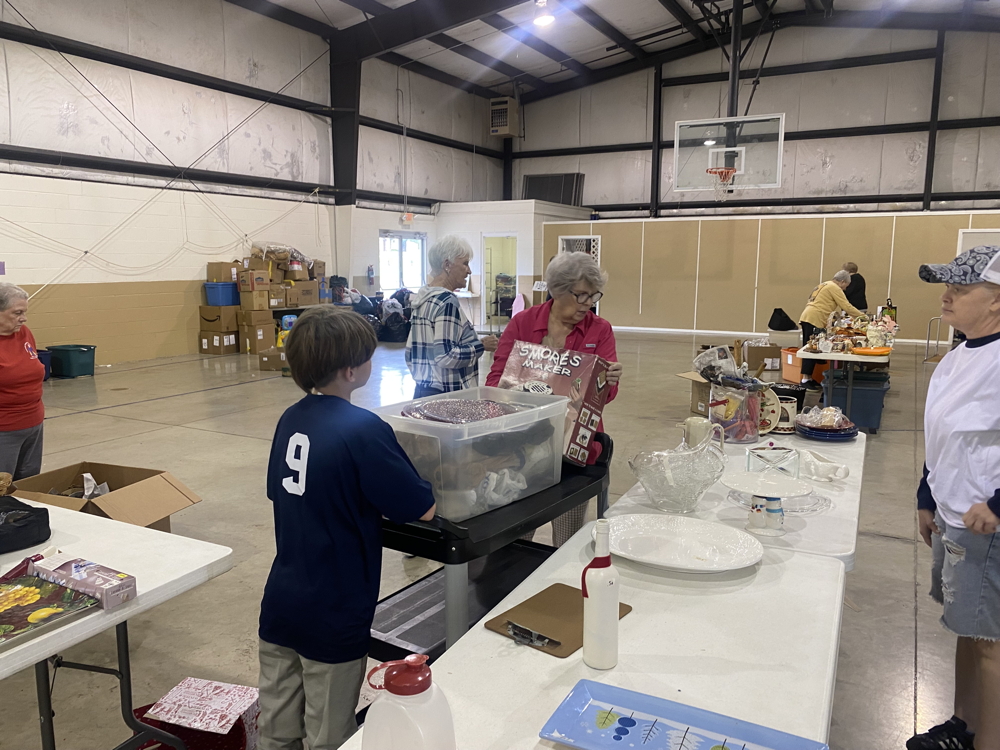
We have just finished the second weekend of our church's Spring Yard Sale. For many of the Yard Sale volunteers - the people who make the event happen - this was one in a long line of Yard Sales that they have worked. Thanks to their energy, commitment to the cause, and willingness to do this work, much good is accomplished. Our Presbyterian Women are able to help with ministry in our church and impact the world by giving to organizations in our community and places far away.
Our folks know that each day is a gift and when we are living the gift of our days it is at every age an opportunity to do good as we follow Jesus. Young or old or somewhere in between, we all have the capacity to produce fruit. Whatever our age, tomorrow is an opportunity to serve and impact the world with our energy, intelligence, imagination, and love.
April 17
First Reading:
Exodus 16:23-26
Psalm: Psalm 96
Second Reading:
1 Peter 3:13-4:6
Gospel: John 16:1-15
"Always be ready to make your defense to anyone who demands from you an accounting for the hope that is in you, yet do it with gentleness and respect." - 1 Peter 3:15
Are you comfortable talking about your faith? In any setting? If people ask you why you believe what you believe, and if it makes any difference in your life, how would you answer? It is important that we give these kinds of questions some thought, because it is important that we be able to answer in the affirmative. For a follower of Jesus, our faith is at the core of our identity. It is good news. Good news that we have experienced and good news for us to share.
To clarify, I am not suggesting that every conversation has to find its way to matters of faith. What I am saying is that if we are living our faith and acting our faith in our daily lives, at some point someone is going to ask us about it. They will wonder why we give a priority to gathering for worship on Sunday morning. They might ask how you were able to find your way through a particularly difficult moment in your life. They may ask you something as basic as how you can believe a person who was dead was brought back to life.
Such questions are invitations and opportunities. In such moments we have an opening to tell the story of how God's good news has made a difference in our lives. This is not being pushy or overbearing - this is articulating what we believe is the source of our hope and, by providing real examples from our lived experience, demonstrating that faith is not a set of ideas and concepts, but a relationship with the God who made us and loves us.
April 16
First Reading:
Exodus 16:10-22
Psalm: Psalm 47
Second Reading:
1 Peter 2:11-3:12
Gospel: John 15:12-27
"I do not call you servants any longer, because the servant does not know what the master is doing, but I have called you friends, because I have made known to you everything that I have heard from my Father." - John 15:15
This is a beautiful, intimate moment between Jesus and his close friends. When we take into account who we believe Jesus to be, it becomes all the more astonishing. Jesus is being very clear about his deep affection for his friends. "I have called you friends." It brings to mind the hymn "What A Friend We Have In Jesus." Seriously, what better friend could we have?
It's also helpful to consider the way that Jesus defines their friendship. It is built on transparency. On communication. What the Father has made known to Jesus, Jesus has made known to his friends. This is the level of sharing that exists in our relationship with the risen Christ. Jesus reveals the heart of God to us, and invites us to share our deepest joys and concerns with him.
Over the years I have developed a real love for the doctrine of the Trinity. That in the Father, Son, and Holy Spirit, God within God's self is about relationship. Relationship is an essential attribute of God. God made us to be in relationship with him and with one another. The level of sharing that Jesus talks about in this passage points to the amazing truth that one of the ways to best describe what develops over a life of worship, prayer, service and growth in faith is we become better, deeper and more faithful friends of God.
April 15
First Reading:
Exodus 15:22-16:10
Psalm: Psalm 9
Second Reading:
1 Peter 2:1-10
Gospel: John 15:1-11
"But you are a chosen people, a royal priesthood, a holy nation, God's own people, in order that you may proclaim the excellence of him who called you out of the darkness into his marvelous light." - 1 Peter 2:9
There are certain Bible verses that I think of as "tape to the mirror" verses. The kind of verses that are perfect to be the first thing we cast our eyes upon when we flip on the light and have a look at our disheveled selves in the morning. Whether we roll out of bed with a spring in our step, or we slowly make our way into the new day, these "tape to the mirror" verses are bedrock motivation to open our eyes and awaken expectancy for what God has waiting for us.
1 Peter 2:9 is the perfect "tape to the mirror" verse. It's a trumpet blast assessment of who God declares us to be - a chosen people, a royal priesthood, a holy nation, God's own people! You! Yes you, who can't get the cap off the toothpaste, you are pretty special according to the creator of everything.
Being reminded of God's vision of who we are and what we can be is a great springboard into considering the activities of the day that awaits us. How might I interact with people differently when I'm guided by the knowledge that I'm one of God's own people. Stumbling in darkness is not our destiny, we've got God's marvelous light calling us forward. These verses remind us not to dismiss what is possible when our hearts are set on listening for and serving God. There is God's excellence to proclaim and we, each one of us, are just the people to do it. Let's go!
April 14
First Reading:
Exodus 15:1-21
Psalm: Psalm 98
Second Reading:
1 Peter 1:13-25
Gospel: John 14:18-31
"Instead, as he who called you is holy, be holy yourselves in all your conduct, for it is written, 'You shall be holy, for I am holy'" - 1 Peter 1:15-16
Be holy. It is an interesting challenge, obviously biblical, as we just read it in the Bible, and yet one that may make us somewhat uncomfortable. The word holy may itself be off-putting. Not due to opposition to holiness as much as a deep awareness that we don't feel particularly holy. To aim to be holy can feel at odds with aiming to be humble.
Still here it is and it is useful for us to consider it. To be holy is not to proclaim ourselves holy, or to attempt to elevate ourselves as in some way better than others. The call to be holy is an exhortation to aim to live as closely in fidelity to Jesus as we possibly can. An honest look at our lives should keep us humble in the attempt - we will fall short, probably repeatedly - but it should not keep us from making the effort.
The original disciples are a great example of a group of people who, in following Jesus, aimed at holiness in their own lives. They literally left their lives prior to meeting Jesus in order to pursue life following Jesus. They reprioritized everything, so that the priority was Christ. To aim to be holy is not to aim for some sort of spiritual winner's circle. It is simply to aim to live in alignment with Jesus. Such a goal should be enough to keep us busy all the days of our lives.
April 13
First Reading:
Exodus 14:21-31
Psalm: Psalm 97
Second Reading:
1 Peter 1:1-12
Gospel: John 14:8-17
"If in my name you ask me for anything, I will do it. If you love me, you will keep my commandments." - John 14:14-15
Far too often I have heard John 14:14 referenced as though what Jesus is saying is ask me for anything and I'll do it. Like Jesus is a waiter anticipating our order and everything we can imagine is on the menu. I don't think that is what this passage says at all. Here's why.
First, Jesus says "If in my name you ask me for anything…." He doesn't say "if you ask me for anything" and that is a significant difference. Asking for something in Jesus' name implies that whatever we are asking for is aligned with the will of Jesus. There are a variety of things I can think of to ask for that Jesus would at the least have serious questions about and in many instances might be completely misaligned with Jesus' will for my life. This brings to mind the phrase in the Lord's prayer, "thy will be done." God's will is the focus of our aim.
To reinforce this, Jesus follows the statement about asking for anything with the statement "If you love me, you will keep my commandments." Our goal is to reflect the love we have received back to our Lord. We do this by making it our intention to follow his will. We will not always get that right. In that instance grace and forgiveness is available. In our intention to follow God’s will though, it is hard to imagine that simply asking for whatever we can think of is going to be the best way to hit the mark.
April 12
First Reading:
Exodus 14:5-22
Psalm: Psalm 136
Second Reading:
1 John 1:1-7
Gospel: John 14:1-7
"Do not let your hearts be troubled. Believe in God; believe also in me." - John 14:1
"O give thanks to the Lord, for he is good, for his steadfast love endures forever." - Psalm 136:1
Psalm 136 leaves no question as to the Psalmist's belief about the love of God. It endures forever. He says it twenty-seven times in the space of twenty-six verses to drive home the point. The refrain is woven in among a retelling of the liberation of the Hebrew people from bondage in Egypt. With each step, each action, each movement from slavery to life in the land that God promised the point is continually made - God's steadfast love endures forever.
Jesus speaks words of invitation to a life secure in the love of God for God's people. By prioritizing belief in God and belief in God's Son, we can embark on life where our hearts need not be troubled. It is not a promise that there will never be troubling things, but a promise that when we are rightly oriented to God, whose love does indeed endure forever, we have cast our lot with a power higher than anything that would threaten us. With the Psalmist we can weave the refrain of God's enduring love into the story of our lives.
Today in worship we read the story from John 20 of Jesus appearing to the disciples following his resurrection. As Jesus shows his friends the wounds in his hands and in his side, we are reminded that the love he showed for us was a love that left a mark - it was in no way easy or within suffering. Still it was love, a profound love that overcame all that death could offer. A love creating new possibilities for us and for all of God's creation. A love that endures forever.
April 11
First Reading:
Exodus 13:17-14:4
Psalm: Psalm 92
Second Reading:
2 Corinthians 4:16-5:10
Gospel: Mark 12:18-27
"The Lord went in front of them in a pillar of cloud by day, to lead them along the way, and in a pillar of fire by night, to give them light so that they may travel by day and by night." - Exodus 13:21
"…for we walk by faith, not by sight." - 2 Corinthians 5:7
I do a lot of walking by sight. Both literally and figuratively. I am grateful for the gift of sight that lets me see where I am going and to see obstacles and directions offered along the way. And I am also thankful for information and guidance that helps me to make informed choices about how to proceed when making decisions that will determine future direction.
I also think a lot about following Jesus. Listening for Jesus in scripture and in prayer, in worship and through the voices of others, to discern and know how to do that following. But there are times when this following is not so simple. When I have lost sight of Jesus or am struggling to hear Jesus' voice clearly, and am wondering how to proceed with choices or decisions with which I am faced.
2 Corinthians teaches us we walk by faith, not by sight. The encouragement here seems to be to lean into faith when finding a way forward is hard. But I like our Exodus passage as well. This story has always been vivid in my mind, possibly due to an illustrated Bible storybook my parents read me as a child. The picture of the cloud by day and the fire by night captured my imagination then and remains a symbol of comfort to me now in my faith journey. God knows that the people need the awareness of his presence and assurance that they have not lost their way in the wilderness. So the fire and the cloud. I believe today that scripture, participation in the life of a worshiping community, and prayer are ways that God continues to offer us cloud and fire - ways to direct our attention to God and to watch for where God is leading.
April 10
First Reading:
Exodus 13:1-2,11-16
Psalm: Psalm 96
Second Reading:
1 Corinthians 15:51-58
Gospel: Luke 24:1-12
"But these words seemed to them an idle tale, and they did not believe them." - Luke 24:11
In Luke's resurrection account, the women go to the tomb, find it empty, and encounter angels who give them the explanation for Christ's absence from the bonds of death. They go back and share the news with the apostles. Luke says the story of the good news encountered at the tomb lands as though it was "an idle tale."
I don't know what the feeling was in the room at that moment, but the description has always suggested dismissal. As though they weren't even really listening and trying to understand, but had simply switched off the story as a kind of irrelevant background noise. They were too enveloped in their grief and sadness to hear a story that called its cause into question.
Once again, Peter is the exception. He hears the story and something in it tells him to get a move on. He leaves immediately and runs to the tomb. This speaks well of Peter. This is a place where I want to be like Peter. I want to be able to listen intently so as not to miss witnesses to God's good news. I want to not be so caught up in the inevitability of tragedy that I fail to respond to news of tragedy undone. I want my curiosity always to be engaged, and I want to run to the tomb when I hear the news that it is empty.
April 9
First Reading:
Exodus 13:3-10
Psalm: Psalm 47
Second Reading:
1 Corinthians 15:41-50
Gospel: Matthew 28:16-20
"When they saw him, they worshiped him, but they doubted." - Matthew 28:17
This is such a great verse. It is so honest. The disciples are with the risen Christ. He's clearly there with them and they are moved to the point of worshiping him. But they just can't chase the doubt away. Even after everything and the evidence standing there before their eyes, they doubt.
I want to think about the nature of that doubt for a moment. I don't think it was an "I don't believe any of this happened" sort of doubt. I'd imagine it was more of a "I don't have any way of explaining how any of this happened" variety of doubt. The sort of doubt where you are afraid to take your eyes off Jesus, for fear that when you look back he won't be there and you'll find you've woken from the dream in which you've been living.
We encounter the kind of doubt they were experiencing regularly. It's not that we don't believe that Jesus rose and reigns in power for us. It's that when we think of the things we truly desire God's help with, we often can't think of a way of making it better which leads to us imagining that it must be impossible to make better. Jesus was patient with them and is equally so with us. We trust and we doubt, and as we walk with Jesus we learn day by day to trust more and leave doubt behind.
April 8
First Reading:
Exodus 12:40-51
Psalm: Psalm 99
Second Reading:
1 Corinthians 15:29-41
Gospel: Matthew 28:1-16
"…indeed, star differs from star in glory." - 1 Corinthians 15:41
We are each one unique. And even within our uniqueness, we are unique over time. Who we were five years ago are not who we are now. If by no other means than the process of physical aging we are changing. Of course, there is far more going on than the physical aging process. Circumstances change. The joys and the hardships of life act on us. We learn new information. We carry who we have been, but we are always becoming something new.
Paul is answering a question about what our resurrected selves will be like. Being Paul he uses more words than simply saying he really doesn't know. What he does say, as I read it, is that God will do what God will do and we will learn about it when we get there.
This is really the truest answer to so many things related to God and to the future, both in this life and in what lies beyond. People differ from other people, people differ from themselves over the same lifetime, what God asks of each person differs…star does indeed differ from star. Our goal is not to divine the sort of star we will be, but to trust that God is at work in our lives and in the creation and we are, each one, a part of the constellation that God is calling into being.
April 7
First Reading:
Exodus 12:28-39
Psalm: Psalm 98:
Second Reading:
1 Corinthians 15:12-28
Gospel: Mark 16:9-20
"But in fact Christ has been raised from the dead, the first fruits of those who have died." - 1 Corinthians 15:20
Paul is explicitly and emphatically stating the fact of his belief in the resurrection of Jesus Christ. He is intentional in making multiple straightforward, unequivocal statements. The victory over death is not won without a death and a resurrection. In the absence of a victory over death, Paul argues, the whole Christian project is not what it purports to be.
One suspects that then, as now, resurrection is hard to wrap one's mind around. It doesn't happen. We have no other resurrection to point to as a means of building our case. The singularity of the event can make it problematic to the point that well-intentioned people seek after alternative explanations for what happened. Paul is saying that not only is there no alternative explanation, but that if there was an alternative explanation, Christian faith would not be what it is - good news of hope and life for our world.
The idea of the resurrection of Christ has been with me as long as I can remember. Well back into my childhood, to my days in Sunday School and Saturday morning Bible club, along with stories read to me at home. As a child it never occurred to me to question it, and this is one aspect of the faith of my childhood that my adult self has never felt called to revisit. As a child I believed it because that was how the story went. As an adult I continue to believe it because that is how the story goes, and I believe God can take a story in whatever direction God chooses. Additionally, I believe, with Paul, that the resurrection is central. I understand that it can be a challenge for us - again that's not new, it has been a challenge as long as there have been people hearing the story and trying to work through how it happened and what it can mean. Still, it is the resurrection and the empty tomb that are the essential yes at the end of Holy Week, the transformational yes for all of history.
April 6
First Reading:
Exodus 12:14-27
Psalm: Psalm 97
Second Reading:
1 Corinthians 15:1-11
Gospel: Mark 16:1-8
"They had been saying to one another, 'Who will roll away the stone for us from the entrance to the tomb?' When they looked up, they saw that the stone, which was very large, had been rolled back." - Mark 16:3-4
A group of women, followers of Jesus, were making their way to the tomb to care for Jesus' body. The problem occupying their thoughts is how are they going to move the stone that blocks the entrance to the tomb. It's a practical concern and they aren't wrong to wonder as it has to be dealt with before they will be able to carry out their task. Lost in conversation about possible solutions, they look up to see that the problem they had identified does not exist. The stone, the very large stone, had been rolled out of the way.
The next thing they'll learn is that there is also no body to care for, Jesus has risen. How often are we of common cause with the women on their way to the tomb? Caught up in solving a problem with which God has already dealt. Based on the new information there is plenty for the women to consider as they think about future actions, but moving the stone is no longer on the list.
It's not foolish to give energy to how we will deal with obstacles we know are ahead of us. Prayerfully considering how we will meet the challenges we envision before us is wise use of our time. Also important, however, is occasionally glancing ahead to see how God is acting in the circumstances that cause us the greatest concern. Stones may have already been rolled away. Something entirely new may be happening.
April 5: Easter
First Reading:
Exodus 12:1-14
Psalm: Psalm 93
Second Reading:
John 1:1-18
Gospel: Luke 24:13-35
"Now on that same day two of them were going to a village called Emmaus, about seven miles from Jerusalem…." - Luke 24:13
The "same day" in question is Easter. It's the evening of the day of resurrection and two followers of Jesus are leaving Jerusalem and heading for home. It's a fascinating encounter between the risen Christ and two of his followers who do not recognize that it is the Lord in their midst until he breaks bread at table with them. For tonight though I'm really most interested in the opening detail of the passage - that two of them were well on their way home from what they were certain was their dreams being laid to waste.
This story is a great example of how hard it can be to know the true nature of the story in which we find ourselves. The two followers had imagined themselves in the story of a person who was going to transform their nation. Which they had both right and a bit wrong. Yes Jesus would be transforming many things, but no, likely not in the way that they imagined. Then they believed they were in a world where the one they had been counting on for this transformation had been executed, which meant he was dead. Their hopes were dashed. Except that they weren't dashed at all, because Jesus who had been dead was now alive. Finally comes the moment at table where Jesus breaks the bread and their eyes are opened and they recognize him. Back to Jerusalem they went, bearing news that would update the reality in which Jesus' followers would now be living.
Easter Sunday is our reminder that the resurrection has happened and that this is good news that fundamentally shapes our reality. As we make our choices and decisions, as we encounter circumstances that seem to cloud out any good possibilities, as we journey on our own Emmaus roads, Easter tells us that our world is a world where Christ lives and continues to be present and make himself known in the breaking of bread. God's blessings be with you on this Easter Sunday.
April 4: Lent Day 40,
Holy Saturday
First Reading:
Lamentations 3:37-58
Psalm: Psalm 43
Second Reading:
Hebrews 4:1-16
Gospel: Romans 8:1-11
"For somewhere it speaks about the seventh day as follows, 'And God rested on the seventh day from all his works.'" - Hebrews 4:4
We have arrived at the final day of the season of Lent. Holy Saturday. This would be the day that Christ was in the tomb. His friends, in shock from the events of Good Friday. Undoubtedly observing the Sabbath with the heaviest of hearts. It will be morning before the women go to the tomb and discover that Jesus has risen. Today would be the Sabbath and so today they would have, as best they could, rested.
Singer/songwriter Andrew Peterson has a wonderful song with the name God Rested that unpacks the idea of the day Jesus spent in the tomb as the day God rested. Peterson goes back to the creation story remembering the six days of the work of creation and the seventh day dedicated to rest which set the model for what became the practice of Sabbath. The song ends with these words:
The sun went down
The Sabbath faded
The holy day was done and all creation waited
Which is what we do now on this final day of Lent. We rest and we wait for the unfolding of our celebration of Easter. Unlike those folks who rested in heavy grief the day before that first Easter, we can anticipate what is coming. We can lean into the expectation of joyfully singing "Jesus Christ Is Risen Today" after beginning our worship with the call and response of, "Christ is risen, Christ is risen indeed." But we do well to rest. Because beyond the Easter celebration is the Easter life we are called to live, a life of grace, thanksgiving, and love.
April 3: Lent Day 39, Friday of Holy Week
First Reading:
Lamentations 3:1-9, 19-33
Psalm: Psalm 22
Second Reading:
1 Peter 1:10-20
Gospel: John 13:36-38
"The steadfast love of the Lord never ceases, his mercies never come to an end; they are new every morning; great is your faithfulness." - Lamentations:3:22-23
The verses from Lamentations about the never ceasing steadfast love of the Lord and God's endless mercies that are new every morning may feel a bit out of sync with the tone of Good Friday. This is the evening when we will gather for our Tenebrae service at church, a service of light to darkness. When we are in the sanctuary and the candles, one by one, are extinguished as we remember the sacrificial love of Christ on the cross, our minds will likely not drift to sunrises and promises of new blessings. With all of that in mind, make sure and read the rest of the Lamentations passage. It's an eyes wide open slog, with themes that are dark and heavy and completely grasp what it can mean to struggle with our faith.
Psalm 22 has a similar character. It begins with words that Jesus repeats on the cross, "My God, my God, why have you forsaken me?" (22:1) Stay with it though and we discover a model for battling through uncertainty about the presence of God, a model that ultimately guides us to a place of affirmation of God's greatness and dependable love. What begins with the most gut-wrenching cry for help finds its way not only to proclaiming faith for the present, but hope for tomorrow. "…future generations will be told about the Lord, and proclaim his deliverance to a people yet unborn." (22:30-31)
I had the opportunity to preach at our Community Holy Week service this afternoon and I'm always of two minds about preaching Good Friday. I don't want to rush ahead and not fully be present in the events of the day, and I also don't want to preach as though Easter hasn't happened. In a way, looking for the balance that we find in Lamentations and Psalms of sitting and meditating in the darkness, while trusting for the sunlight of the morning. Here's how this afternoon's message finished up…
Friends,
what we must always remember,
is that we are God's Easter People.
All the time.
All the time.
All the time.
When life could not be better.
When everything is coming up roses,
we are Easter people.
AND, AND, AND,
when our hearts are heavy
and we imagine
we cannot go another step.
When darkness and gloom settle,
when death is at the door.
We are Easter people.
And we know that
when death is standing there
holding a flashing neon sign that says
THE END
it's time to buckle up
because
the story is just getting started.
Our story begins at the cross.
This is the story of God.
So this day,
this Good Friday,
standing at the cross of Christ,
it looks like an ending.
April 2: Lent Day 38, Thursday of Holy Week
First Reading:
Lamentations 2:10-18
Psalm: Psalm 126
Second Reading:
1 Corinthians 10:14-17, 11:27-32
Gospel: Mark 14:12-25
"While they were eating, he took a loaf of bread, and after blessing it he broke it, gave it to them, and said, 'Take; this is my body.' Then he took a cup, and after giving thanks he gave it to them, and all of them drank from it." - Mark 14:22-23
I can't really guess how many times I've participated in the observance of the Lord's Supper. How many different locations? Churches. Camps. Retreat Centers. Homes. How many different types of bread? We had wonderful homemade bread tonight on this Maundy Thursday, prepared by Becky, a church member. How many different faithful church members over the course of history have made sure there is bread for the meal? Wine or grape juice for the cup?
It is a lot to think of the table and its preparation all across the centuries. All done at the direction of Jesus. Following his instruction on that first celebration of this meal in the upper room at the occasion of what we call Jesus' last supper with his disciples. On the one hand it is so ordinary, bread and a cup. And on the other hand, of course, so profoundly beautiful and deeply meaningful.
If a family is going to survive for any amount of time, that family must eat. It must be nourished. And so we are. Nourished. Fed and reminded of our Lord and of his great love for each of us. A love so great that nothing was held back. Giving his body. Pouring out his blood. Loving us as the Gospel of John reminds us "to the end." (13:1) What the next several days will remind us is that he did indeed love us well to the end, but it didn't stop there. He loved us to the end and then beyond. And so, with a simple meal that means everything, begins a journey that continues to transform the world.
April 1: Lent Day 37, Wednesday of Holy Week
First Reading:
Lamentations 2:1-9
Psalm: Psalm 5
Second Reading:
2 Corinthians 1:23-2:11
Gospel: Mark 12:1-11
"What then will the owner of the vineyard do?" - Mark 12:9
The Westminster Study Bible in a footnote referencing this passage mentions among its themes "sending" and "suffering of messengers." In this parable person after person is sent by the owner to seemingly deal in an honest and open way with the people. Each time they respond by mistreating the messenger and ultimately killing the owner's son when he is sent as the messenger.
In a related note, I read a piece today, asking the question of how it is that Jesus is so clear on the things he asks us to do and we are so able to very often continue on along as though we've heard nothing of what Jesus has said or is saying. It's a fair question. When I examine my own life, my choices, my decisions, my actions, I can find many gaps between them and what I would articulate to be what Jesus is asking me to do. These gaps are worth spending time with in contemplation and in conversation with God.
As we read Jesus' parable from this distance I don't believe the primary takeaway for us is to try and decide who wasn't following Jesus properly two thousand years ago and assign blame. I believe the call I feel from this parable is to watch for God's messengers and messages, aiming to receive them with gratitude and strive to live into them in ways that are faithful and life-giving.